Alpha 2 Release
Devlog: November 2025 – February 2026
Alpha 2 is Here — Here's What Changed
It has been a big few months for Rogue Deck Builder. Since November we have shipped Alpha 2, ported the game to WebAssembly so it runs in the browser, added new resource types, new enemies, a new card type, a world section editor, and fixed a pile of bugs large enough to fill a condemned neighbor's garage. Here is a high-level account of what happened and why.
A Whole New Economy: Metal, Concrete, and the Cars That Deliver Them
I expanded the resource system beyond wood.
Concrete is now harvestable from sidewalks. When you destroy a section of suburban sidewalk, you get concrete you can spend on buildings and upgrades. It fits the setting perfectly — you are literally tearing up the neighborhood to build your dream deck.
Metal comes from cars. This one is arguably even more satisfying. Parked cars now act as a metal source. Smash one for scrap, and you have the raw material to build structures that would otherwise be out of reach. Cars have full collision geometry, render at the correct scale, and disappear properly when they reach the edge of the map. Several car-related bugs were fixed along the way — including one where cars had no collision rectangle at all and another where they simply vanished at screen edges.
Building cards now require metal costs. The costs system got a full refactor to support multiple resource types cleanly, so future resource additions will be straightforward.
The Deckbuilding Affects the Deckbuilding
The biggest design shift was throwing out the old deck building system (the patio not the cards) and replacing it with something new that makes the game play like a true Roguelike Deckbuilder.
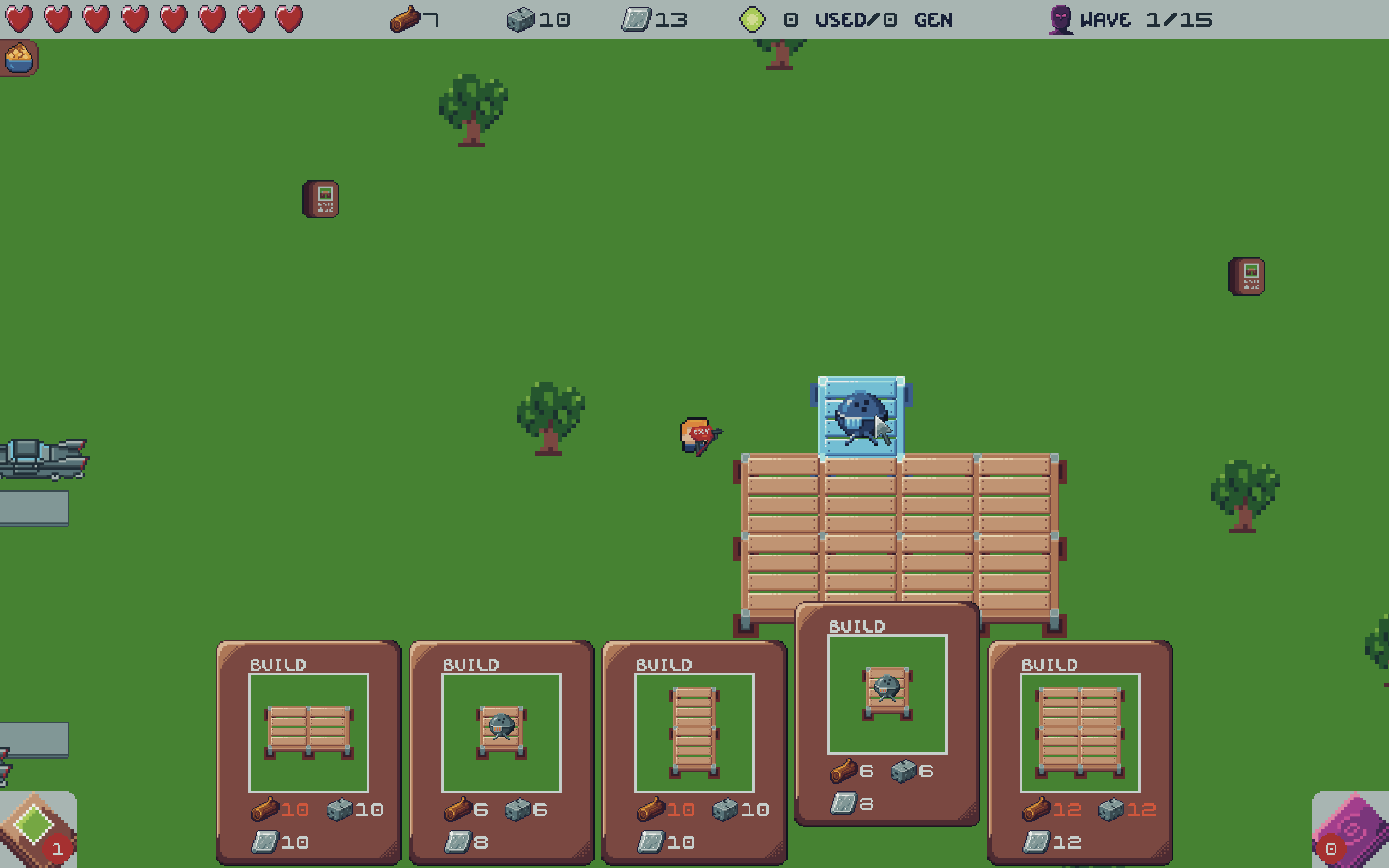
Instead of placing down individual postholes, joists, and deck panels, you now have the option play a Building Card or an Action Card.
The player has a deck of these cards, and just like in Slay the Spire, there is a Draw Pile and Discard Pile. You walk around the neighborhood finding new cards to add to your deck, and the way you combine the cards has a strategic significance.
Building cards have a little section of the deck on them. They cost some combination or lumber, wood, and concrete. These cards can have defensive turrets, solar power, or other helpful buildings on them.
Action cards let you do things with your deck. You can move a turret to a better position. You can play a modifier card before an action card. If you use Triple Play before Move, you now get three move actions for the price of one.
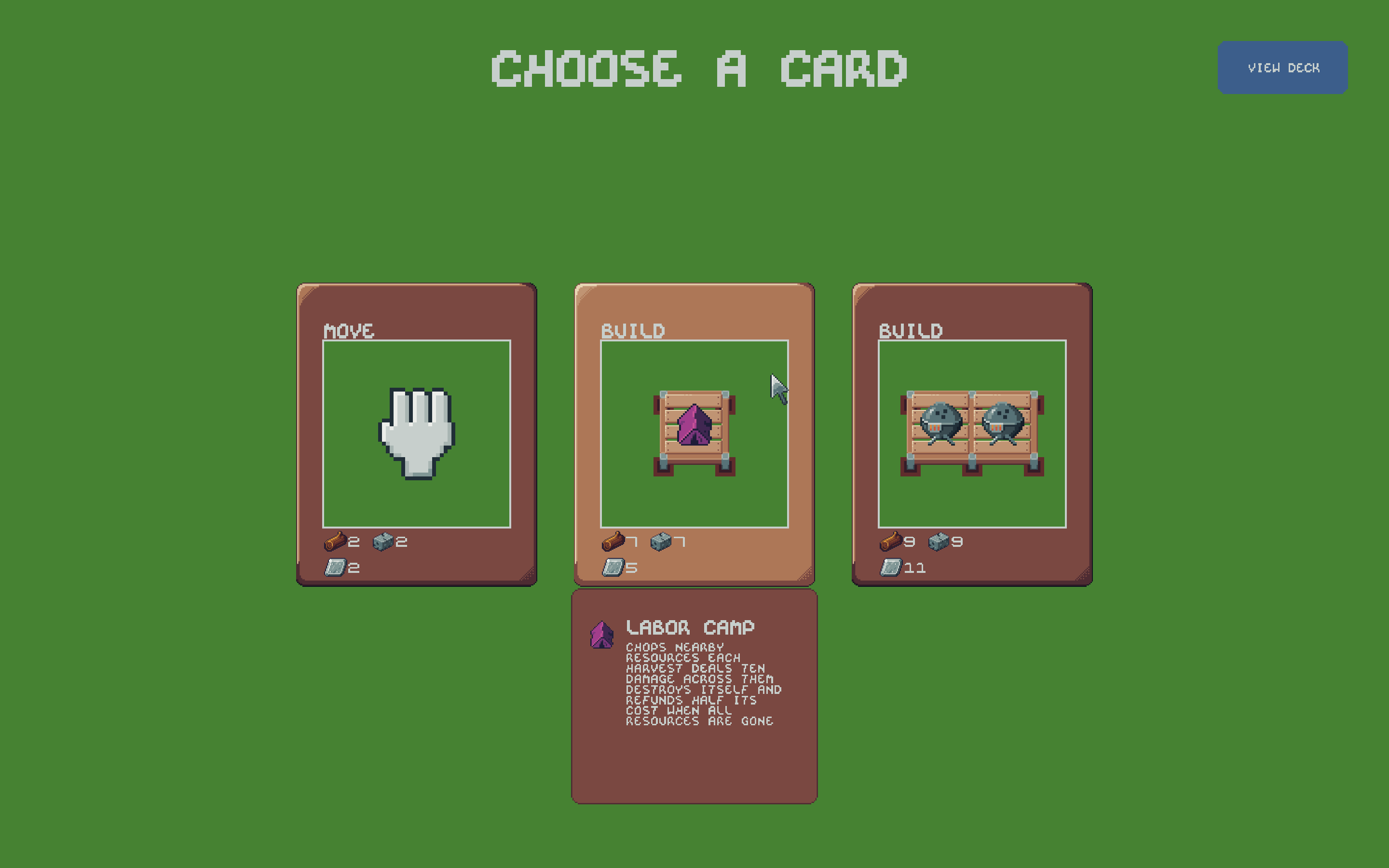
The Labor Camp Card
This is the card I am most excited about. The Labor Camp is a building you place next to a resource. Every 30 seconds it extracts that resource automatically, delivering it to your stockpile without you having to do anything. Place it strategically next to a scrap yard of cars or a long run of sidewalk and your economy starts running itself.
Several improvements shipped on top of the initial implementation:
- You can now see the labor camp's extraction radius while moving it during placement, so you know exactly what it will reach before you commit.
- Extracted resources visually pop out of the labor camp as they are collected, giving you clear feedback that it is working.
- The labor camp self destructs after it runs out of resources to harvest. If you're clever, you can use the Move card to move it to a new location before this happens.
- A bug with the labor camp's collision geometry was found and fixed, along with a tool icon bug that showed the wrong icon.
A New Enemy: The Ranged Attacker
Previously, all enemies were melee — they charged the deck and smashed it. Now there is a ranged enemy that hangs back and fires projectiles at the player. This changes the defensive calculus. You can no longer assume anything outside your walls is harmless. You need to deal with these enemies before they whittle you down, or build structures that interrupt their line of fire.
A few follow-up fixes tightened up the ranged enemy behavior: they can no longer fire projectiles when they are offscreen, and they can no longer navigate onto the deck itself, keeping the threat to the perimeter where it belongs.
Triple Play and Action Cards
The Triple Play card lets you play the next action card you draw three times. When it works well, it is a big swing — play the right card at the right moment and it can dramatically accelerate your build or your defense.
Action cards now display descriptions in the UI, making it clearer what each one does. The hovered state for cards also got a proper visual treatment so you always know which card is selected. Energy numbers were made clearer so the resource cost of playing cards is easy to read at a glance.
The World Section Editor
One of the bigger behind-the-scenes changes was the World Section Editor — an internal tool for authoring the neighborhood map chunks that surround the player's deck.
Rather than generating sidewalks and house layouts procedurally (and randomly), the map is now built from designed world sections placed around the starting house. This gives much more control over the early game experience. Houses drop different resources depending on the section they belong to, which opens the door for more deliberate resource placement and better pacing in the future.
WebAssembly Port
The game now runs in the browser via WebAssembly. This was a substantial technical effort — fixing compiler errors, handling memory alignment, correcting the viewport size in windowed mode, adjusting tile sizes for WebGL, and getting the artifact screen layout right in the web context.
The payoff is that anyone can now play a session without downloading anything. For Alpha 2 testing and beyond, that removes a meaningful barrier.
New Art: Postholes and Joists
The posthole and joist artwork got a full refresh with new textures. These are the structural elements that hold deck sections together, and they are visible throughout every game. The updated look gives the deck construction more weight and character.
Alpha 2 and Playtesting
Alpha 2 was released to the Charlottesville game group for a live playtesting session on February 24, followed by the public Alpha 2 release. The feedback revealed a few things worth paying attention to going forward:
- Overall, the game has a fairly slow pacing. Many said it should play about 10-15% faster. It could be that harvesting resources takes too much time, there's not enough automation early on in the game, or that it takes too long for enemy waves to arrive.
- Players sometimes assumed the starting house was the most valuable thing to protect, and built a defensive perimeter around it instead of expanding outward. The game's scoring rewards deck size, not house protection, so the intuitive play didn't match the intended play.
- The distinction between building cards and action cards was not clear. If you do not know what an action card looks like, the Triple Play card description does not land.
- The power management system — where all turrets lose power simultaneously when consumption exceeds production — felt punishing without enough player control. The ability to toggle individual turrets off would help.
These observations are feeding directly into what comes next.
Bug Fixes
Beyond the feature work, a large number of bugs were addressed:
- Trees were rendering in front of the deck incorrectly
- Stairway z-layer ordering was wrong
- Deck sections had a z-layer conflict with sidewalk tiles
- Prism tower networking had a logic bug that has since been resolved; hovering a prism tower now highlights all towers in the same network
- The builder's wrench was not functioning correctly
- Resetting the game did not fully clear state
- Stairwells could be placed in situations where they should have been disallowed
- The sidewalk tile layout was interfering with enemy navigation
What's Next
The todo list coming out of Alpha 2 is focused on feel and clarity. The game needs to play slightly faster, enemy threats need to feel more dangerous and intentional, and the card system needs to communicate its distinctions more clearly. There is also a growing content backlog — more resource types, more capturable buildings, more ways to build and defend.
The foundation is solid. Now it is time to make the experience something you cannot put down.
If you want to try it, the game is playable in the browser right now on itch.io. Feedback is very welcome.
Leave a comment
Log in with itch.io to leave a comment.